
citizenship
As Fraenkel explained it, a lawless dictatorship does not arise simply by snuffing out the ordinary legal system of rules, procedures, and precedents. To the contrary, that system—which he called the “normative state”—remains in place while dictatorial power spreads across society. What happens, Fraenkel explained, is insidious. Rather than completely eliminating the normative state, the Nazi regime slowly created a parallel zone in which “unlimited arbitrariness and violence unchecked by any legal guarantees” reigned freely.
. . .The trick was to find a way to keep the law going for Christian Germans who supported or at least tolerated the Nazis, while ruthlessly executing the führer’s directives against the state’s enemies, real and perceived. Capitalism could jog nicely alongside the brutal suppression of democracy, and even genocide.
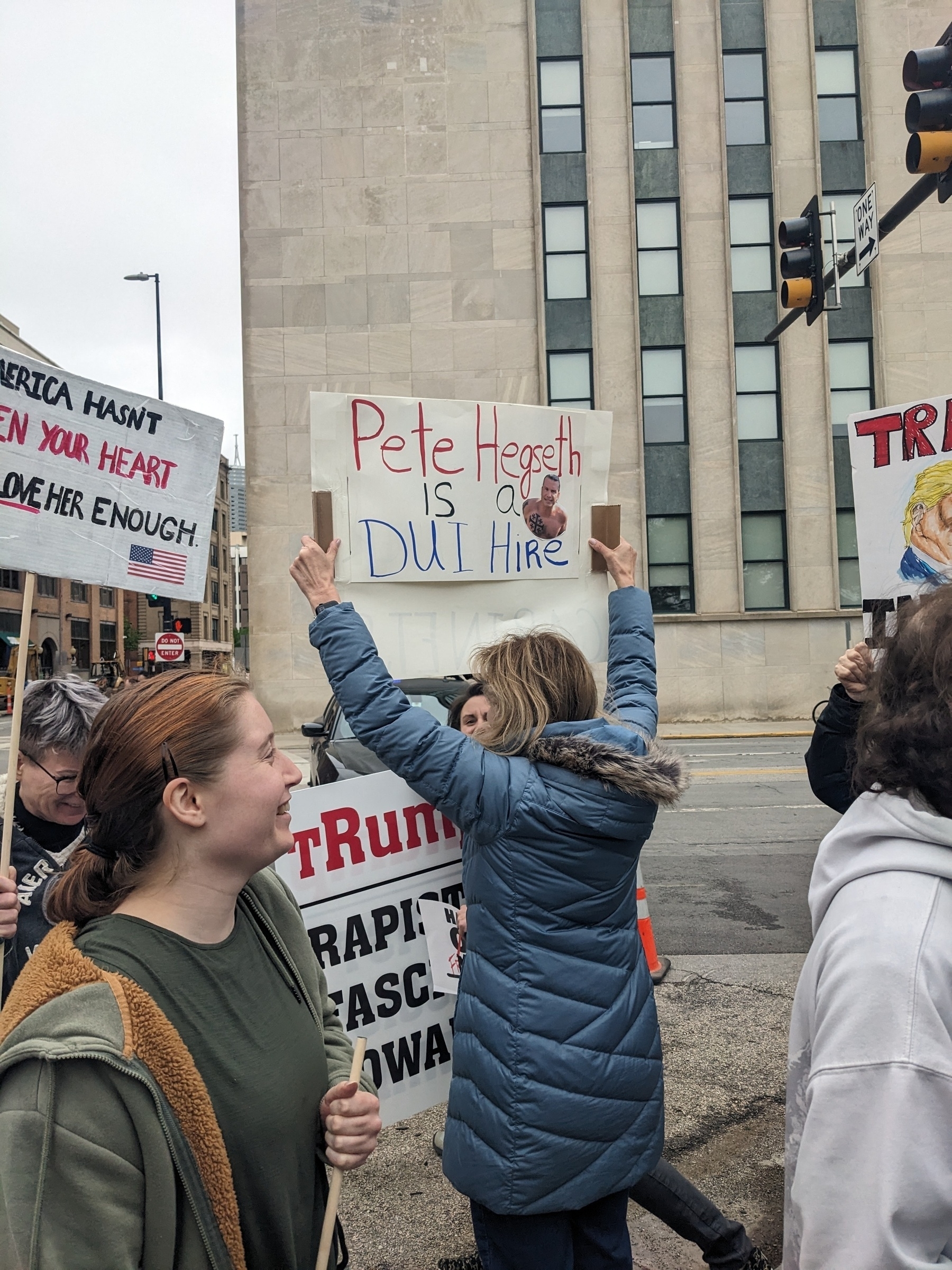
I made a sign that said, “Uphold the Rule of Law.”

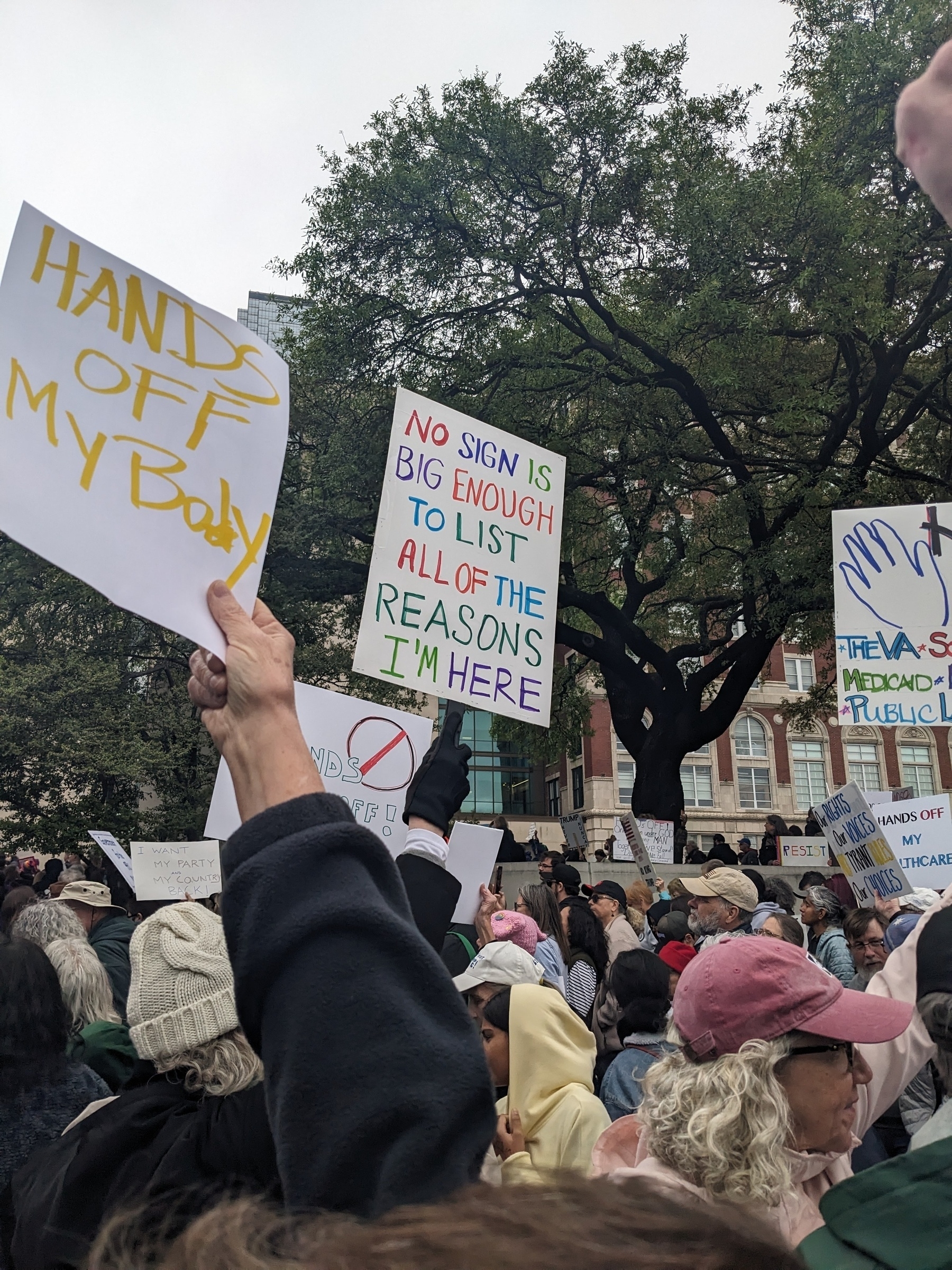
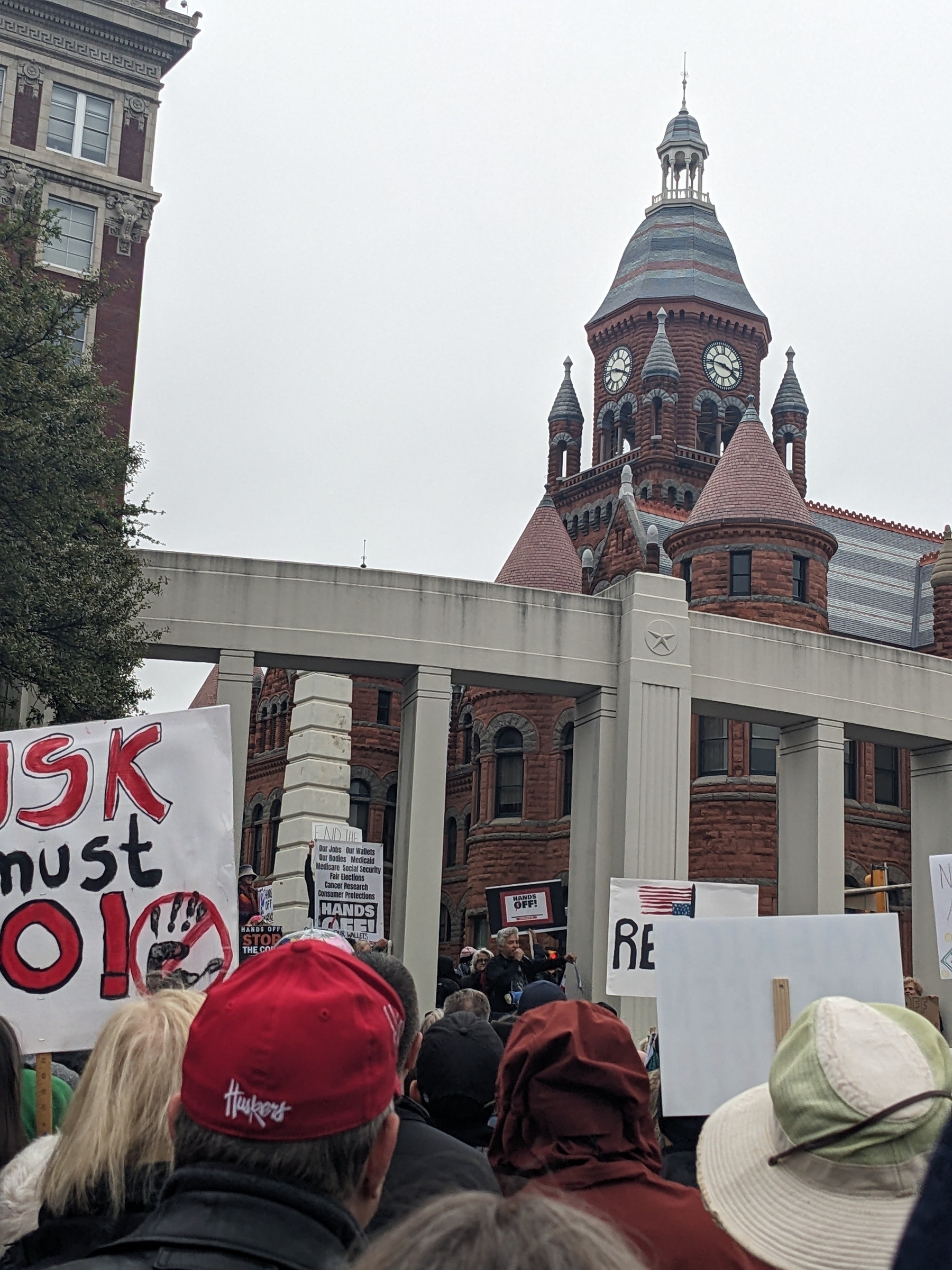
WTF? Although non-citizens don’t enjoy full free-speech protections, they are entitled to due process.
A spokesperson for the Department of Homeland Security, Tricia McLaughlin, confirmed Khalil’s arrest in a statement Sunday, describing it as being “in support of President Trump’s executive orders prohibiting anti-Semitism.”
Khalil’s arrest is the first publicly known deportation effort under Trump’s promised crackdown on students who joined protests against the war in Gaza that swept college campuses last spring. The administration has claimed participants forfeited their rights to remain in the country by supporting Hamas. Time.com
Not letting his wife (an American) or lawyer know where he is being held is especially chilling.
By tapping a guy accused of having sex at a party with a 17-year-old girl to be America’s top law enforcement officer, Donald Trump discovered that even life forms as supine as congressional Republicans have a limit to how much sleaze they can rationalize. But I wonder if, in hindsight, the president regrets letting Gaetz withdraw from consideration instead of daring the Senate GOP to vote him down.
… everything we’ve seen from them since then proves that they do not, in fact, take their jobs very seriously.
The … Trumpist elite think they’re going after the educated elites.. but you know who’s really going to pay? … working-class communities that will continue to languish because Trump ignores their main challenges and focuses instead on culture war distractions… the essence of Trumpism: [is] to be blithely unconcerned that people without a college degree die about eight years sooner or that hundreds of thousands of Africans might now die of AIDS, but to go into paroxysms of moral panic because of who competes in a high-school girls’ swim meet.
Vis a vis the 2025 coup: Checks and balances only work if the other two branches check and balance. Congress and the courts are, um, sick (unto death, for Congress). If they croak, they’ll be very difficult to resurrect.
Of all the dangers to a nation as things exist in our day, there can be no greater one than having certain portions of the people set off from the rest by a line drawn–they not privileged as others, but degraded, humiliated, made of no account.
Plus ça change…
Ted Gioia:
Few things are more distressing than praise lavished on irredeemable ugliness.
At the risk of becoming a yeller-at-clouds, I fret about this in our current media environment: The Joker, American Horror Story, Saw (I, II, III, IV, V, VI, 3D), etc. This can’t be a sign of cultural health, right?
I don’t want people to kill insurance executives, and I don’t want insurance executives to kill people. But I am unsurprised that this happened. Indeed, I’m surprised that it took so long. It should not be controversial to note that if you run an institution that makes people furious, they will eventually become furious with you.
Suffice to say, however, being furious is not justification for gunning someone down.
[W]e are … not going back to a world where there is a set of trusted truth-mediating institutions, core sources of news and information that everyone recognizes and trusts, a “mainstream” of argument and opinion-shaping that sets the parameters of debate. – Ross Douthat, New York Times, 16 Nov. 2024
If true, then we’ll need to learn to think for ourselves. Not that I believe we will. Which is terrifying.
But lets work on it:
Lesson 1: Yes or No: Does hosting a gameshow make a person fit to be the President of the United States of America?
… the narrative on which many of us grew up no longer applies.
– Joan Didion - (h/t @ayjay)
From my friend, Dan Wilson:
… whatever the outcome… “well, we will live right on.” We will all go about doing what we do, get the kids off to school, go to work, do the laundry, and go about our lives. And that is as it should be because the greatest impact on our world does not come out of Washington anyway. It never has. Ultimately, it comes from each of us and how we live out our ordinary lives, our good deeds, humility, loving our neighbor, and loving God.
I was talking today with Megan, who’s serving as a poll worker, and I lost it when I thought of how Trump – solely for selfish, vicious purposes – has cast doubt on the honesty of U.S. elections. Liar. There’s no evidence of any significant fraud. Traitor.
I’ve become convinced that this election isn’t really about Harris and Trump. But I haven’t figured out what, exactly, it is about. (I mean, I know what it’s about for Trump, but I don’t know about Trump voters. Or the country.)
Charles M. Schulz (Peanuts creator):
Sometimes it is the very people who cry out the loudest in favor of getting back to what they call “American Virtues” who lack this faith in our country. I believe that our greatest strength lies always in the protection of our smallest minorities.
… you might conclude that this country has a leadership problem. But it doesn’t. This country has a citizenship problem.
Before Trump took his golden escalator ride, life was different. Then, even if I thought a candidate would make a terrible office holder, I rarely thought he or she was objectively a bad person. Even LBJ, and he was pretty bad on a personal level, or Nixon, who was pretty bad as a leader. One consequence was, while I might have thought folks who supported “the other guy” naive or misguided, I didn’t think of them as bad either.
But Trump by any measure is actually a bad, bad man. And he’s bad in many, many ways. So, that makes my response to his supporters quite a problem. In my life, there are folks I love who definitely will vote for that bad, bad man. I know those folks are not themselves irredeemably bad. But I cannot help but wonder, “What is wrong with them?”
And that is one important reason this is all so exhausting.
Preach, Jaroslav
>Tradition is a good thing. It is traditionalism that is bad. Tradition is the living faith of the dead; traditionalism is the dead faith of the living. Tradition lives in conversation with the past, while remembering where we are and when we are and that it is we who have to decide.
>
>—Jaroslav Pelikan
(h/t blog.angloromanticism.org - btw, my new band name)
Wild Wombats in the White House
... his entire industry is on pins and needles, terribly anxious about a Trump victory. I asked him if it’s because Trump is opposed to his industry on specific policy issues. He said no.
“That’s not it. It’s that Trump is crazy. That’s what we worry about.”
My friend’s business involves putting big chunks of money into long-range investments that already involve plenty of risk. The added risk of wild wombats in the White House with regulatory power over their deal is way too much.
Hate the Sinner, Hate the Sin
David Frum, via Nick Cataggio:
Nobody seems to have language to say: We abhor, reject, repudiate, and punish all political violence, even as we maintain that Trump remains himself a promoter of such violence, a subverter of American institutions, and the very opposite of everything decent and patriotic in American life.
Whatever Happens This Year /
I have said these things to you, that in me you may have peace. In the world you will have tribulation. But take heart; I have overcome the world.
not so funny anymore
Mike Godwin:
... has the sheer absurdity of so many hyperbolic Nazi comparisons in popular culture made us less vigilant about the possible reemergence of actual fascism in the world? I think it shouldn’t — comparisons to Hitler or to Nazis need to take place when people are beginning to act like Hitler or like Nazis...
We had the luxury of deriving humor from Hitler and Nazi comparisons when doing so was almost always hyperbole. It’s not a luxury we can afford anymore.
Public Servant
RIP, Sandra Day O'Connor
You are what you eat
David French:
We’re misinformed not because the government is systematically lying or suppressing the truth. We’re misinformed because we like the misinformation we receive and are eager for more.... The market is very, very happy to provide us with all the misinformation we like. Algorithms recognize our preferences and serve up the next video or article that echoes or amplifies the themes of the first story we clicked.... It’s important to recognize that no person or movement is immune to the temptations of bespoke reality. We’re all vulnerable... That means following as many or more people who disagree with me as agree with me. That means reading the best and smartest people I can find who disagree with me. These practices help both challenge me and humanize my opponents.