We live in a world where violating taboos is monetizable and confers enviable status. I like taboos— not all of them, of course. But I respect the role of taboos in society. Good taboos are the guardians of settled questions. They sit like gargoyles at the mouth of dangerous caves and warn against spelunking in dark and dangerous places. …
The riot of taboo-violating and dogma-disinterring is an invitation to consequences few have the courage or the basic knowledge to apprehend.
If … you conjure a world where there is no external truth, only a riot of competing, equally valid perspectives, then you create a Nietzschean world where the only arbiter of “truth” is the one with the will and the power to impose their truth on everyone else.
faith
They are waiting for me somewhere beyond Eden Rock:
My father, twenty-five, in the same suit
Of Genuine Irish Tweed, his terrier Jack
Still two years old and trembling at his feet.
My mother, twenty-three, in a sprigged dress
Drawn at the waist, ribbon in her straw hat,
Has spread the stiff white cloth over the grass.
Her hair, the colour of wheat, takes on the light.
She pours tea from a Thermos, the milk straight
From an old H.P. sauce-bottle, a screw
Of paper for a cork; slowly sets out
The same three plates, the tin cups painted blue.
The sky whitens as if lit by three suns.
My mother shades her eyes and looks my way
Over the drifted stream. My father spins
A stone along the water. Leisurely,
They beckon to me from the other bank.
I hear them call, ‘See where the stream-path is!
Crossing is not as hard as you might think.’
I had not thought that it would be like this.
I was going to say that my faith, like my doubt, mostly involves my mind and not my stomach. Basically that’s true. I can’t really imagine what it would be like to behold the Lord and not as a stranger. I’m not a saint, so I haven’t had that experience. And yet, even as a not-saint, I get glimpses. I think we all have, and may there be many more of them for all of us.
The Remarkable Ordinary (2017)
… the stars shone in their watches, and were glad;
he called them, and they said, ‘Here we are!’
They shone with gladness for him who made them.
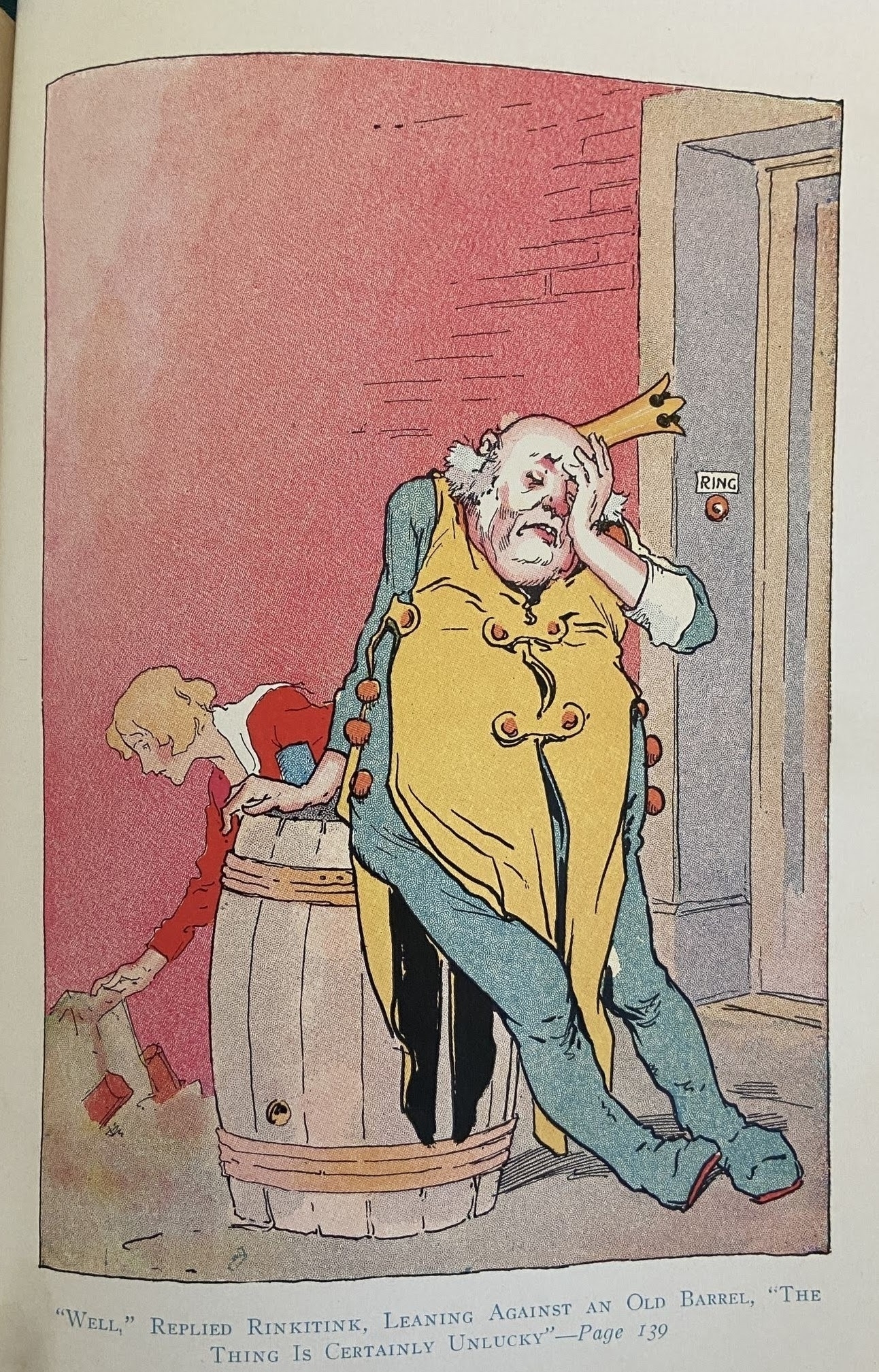
King Rinkitink of Gilgad, by John R. Neill, from Rinkitink in Oz, by Frank L. Baum, 1916
From The Sacred Journey, Frederick Buechner:
For reasons that I can only guess at now, no one I came to know during that first year in Oz left a deeper mark on me than a plump, ebullient king named Rinkitink. He was a foolish man in many ways who laughed too much and talked too much and at moments of stress was apt to burst into unkingly tears; but beneath all that, he gave the impression of remarkable strength and resilience and courage even…
Rinkitink was a very vulnerable man, silly and unstable in numberless ways, but in his fatness he seemed also somehow solid and substantial, eccentric and yet reliable with his slippered feet planted heavily on the ground and his heart in the right place. Like a tree that has been blown for years from so many directions by so many winds that none of them can ever quite blow it down, he seemed strong in his very vulnerability. In his capacity to laugh and weep at the drop of a hat and in general to make a fool of himself, he seemed wise with the wisdom of a child who sees better than his elders that the world is indeed something to laugh and weep about and who, more realistically than the rest of us, accepts his own foolishness as part of the givenness of things. Frightening and terrible adventures befall him in the course of Baum’s book, but somehow he always manages to come riding out of them on the back of his faithful goat Bilbil. The world can wound him and scare the daylights out of him, but never, you feel, can it destroy him. It is only the world of the fairy tale to be sure, but nonetheless he has overcome that world, and I have remembered him with admiration and love ever since.
In different guises (though always fat) and under different names, Rinkitink has haunted me always…
… these books were all childhood or early boyhood reading – but certain patterns were set, certain rooms were made ready, so that when, years later, I came upon Saint Paul for the first time and heard him say, “God chose what is foolish in the world to shame the wise, God chose what is weak in the world to shame the strong, God chose what is low and despised in the world, even things that are not, to bring to nothing things that are,” I had the feeling that I knew something of what he was talking about. Something of the divine comedy that we are all of us involved in. Something of grace.
It is by its content rather than its duration that a child knows time, by its quality rather than its quantity–happy times and sad times, the time the rabbit bit your finger, the time you had your first taste of bananas and cream, the time you were crying yourself to sleep when somebody came and lay down beside you in the dark for comfort. Childhood’s time is Adam and Eve’s time before they left the garden for good and from that time on divided everything into before and after.
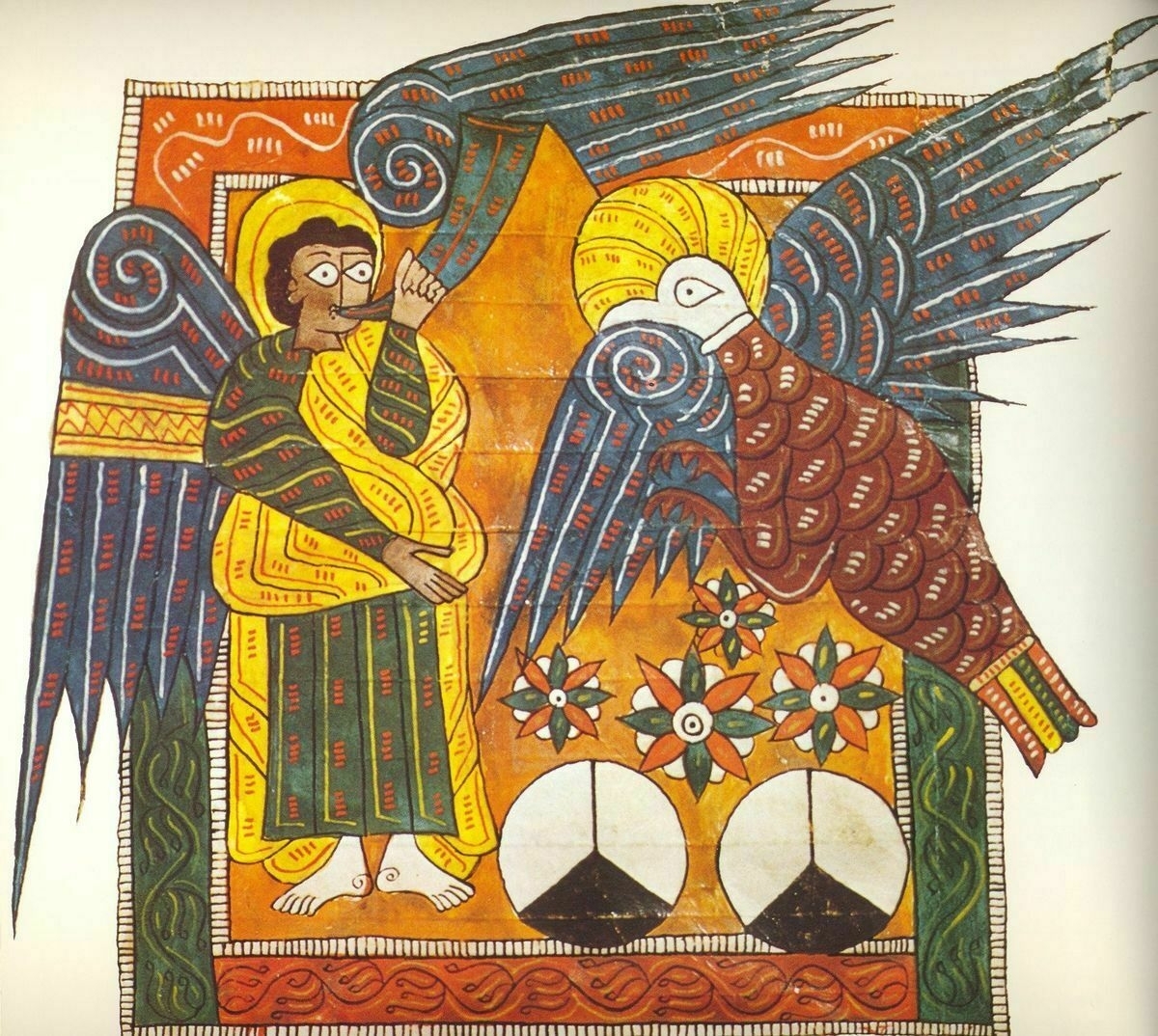
St. John’s Park Slope: wonderful! Alleluia! The Lord is risen!
Malcolm Guite:
Come close with Mary, Martha, Lazarus
So close the candles flare with their soft breath
And kindle heart and soul to flame within us
Lit by these mysteries of life and death.
For beauty now begins the final movement
In quietness and intimate encounter
The alabaster jar of precious ointment
Is broken open for the world’s true lover,

The whole room richly fills to feast the senses
With all the yearning such a fragrance brings,
The heart is mourning but the spirit dances,
Here at the very centre of all things,
Here at the meeting place of love and loss
We all foresee, and see beyond the cross.
Six years after my dad died, three after my mom died, and this year, when my first two grandchildren are born, this resonates. Frederick Buechner, The Eyes of the Heart.
Each time members of the tribe die, the self we were with them dies too, which is to say that the kind of words we spoke only to them, were only to them, and the kind they spoke only to us are spoken no longer. But if outwardly our language is thus impoverished, inwardly it is enriched because when members of the tribe die, the words they were are added to the vocabulary of the heart, where we have more than just ears for hearing them. And each time a member of the tribe is born, a new word comes into being, and nothing is ever the same again.